Skip to content
Request a proposal
Prototic Software · Systems support

Your system online
and current.

We look after the system your company already uses, whether we built it or someone else did. We fix what breaks, with contractual timelines by severity, keep everything up to date and secure, and adjust the system when a law or a vendor changes. Every month, you get a report on what was done.We look after the system your company already uses, whether we built it or someone else did. We fix issues within contractual timelines and keep everything up to date. Every month, you get a report on what was done.

When it makes sense

When the system mattersand no one owns it.

The system your company uses every day still needs care after delivery: bugs show up, components age, laws and vendors change. Without someone accountable, every problem becomes an emergency. See if any of these sound familiar.A system still needs care after delivery: bugs show up, components age, laws and vendors change. See if any of these sound familiar.

A sales manager on the phone looks at the frozen system screen, showing only a loading icon, next to a salesperson waiting with arms crossed.

You needWe do

  1. “Whoever built it no longer answers.”

    We take over the system after studying it, with contractual timelines and a dedicated team.

  2. “Every bug means an endless wait.”

    Severity and timeline in writing on every ticket, with the cause recorded.

  3. “No one has updated it in years.”

    Components get security patches again, tested before they go in.

  4. “New rules change what the system does.”

    We track the rules, like invoicing ones, and adjust with testing before they take effect.

  5. “Only one person knows how the system works.”

    Documentation and access owned by the company, depending on no one, not even us.

  6. “Customers see the error first.”

    Monitoring spots the error and opens a ticket before anyone complains.

Examples by area

What support takes care of,area by area.

Each area feels the system differently: the invoice that has to go out, the month-end close that can't stall, the order that has to arrive. These are examples of what support does when something breaks or changes from the outside.Each area feels the system differently: the invoice that has to go out, the month-end close that can't stall, the order that has to arrive. Here are a few examples.

A finance analyst works on two monitors during the month-end close, with a colleague pointing at the close checklist marked in green on the screen.

ten examples

  • TaxNew invoice rule

    The new tax field goes on the invoice, tested before the date it takes effect.

  • FinanceClose is stuck

    An error that blocks the close is critical: fixed, with the cause recorded so it won't come back.

  • PurchasingAlphanumeric CNPJ

    The supplier registry accepts the alphanumeric CNPJ without breaking search or integrations.

  • SalesApp in the app stores

    The sales team's app stays in the stores, with the version Android and iOS require every year.

  • SupportSlow portal

    The customer portal, slow at month-end, responds again once the query is fixed.

  • LogisticsCarrier changed

    The carrier changes its tracking lookup, and the integration is adjusted before it breaks.

  • OperationsIntermittent error

    An error that comes and goes is traced through the system logs to its cause, not just worked around.

  • ITSecurity patches

    Security patches applied across the system's parts, tested, without waiting for trouble.

  • LegalPersonal data incident

    The company is notified right away, with what happened, so it can report to Brazil's ANPD on time.

  • LeadershipMonthly report

    Tickets, timelines, updates and risks in the monthly report, plus what's coming next.

How we do it

You approve every step.We stand behind each one.

The same care for every system, with one lead from assessment to the monthly report. At each step, you see what we do, what you get, who on your team takes part and what you approve.The same care for every system, with one lead from assessment to the monthly report. At each step: what we do, what you get, who takes part and what you approve.

Step 011 / 6

Assessment

What we do
We get to know the system: the code, the database, where it runs, the access, the documentation and what already causes trouble.
You get
A written assessment: the system's condition, the risks, what to do first and the proposal.
From your company
  • Who decides
  • IT or whoever has access
  • Previous vendor, if any

You approve

Proposal and contract.

In every contract
  • Built to growAn up-to-date system takes improvements without redoing what works.
  • Timelines by severityIn the contract, from critical to medium.
  • Security and LGPDAccess kept in the vault, minimal and reviewed, and only the data support needs.
  • It's your systemCode, documentation and access in the company's name.

The full method, including the tech and the team, is covered in How we work

Trust

Contract timelines.And what we did, in writing.

Support is in the contract: what's covered, the timeline for each severity, service hours and the monthly report. Every fix comes with the cause and what was done, and everything that belongs to the system stays in your company's name.What's covered, the timeline for each severity and the monthly report are in the contract. Every fix comes with the cause and what was done.

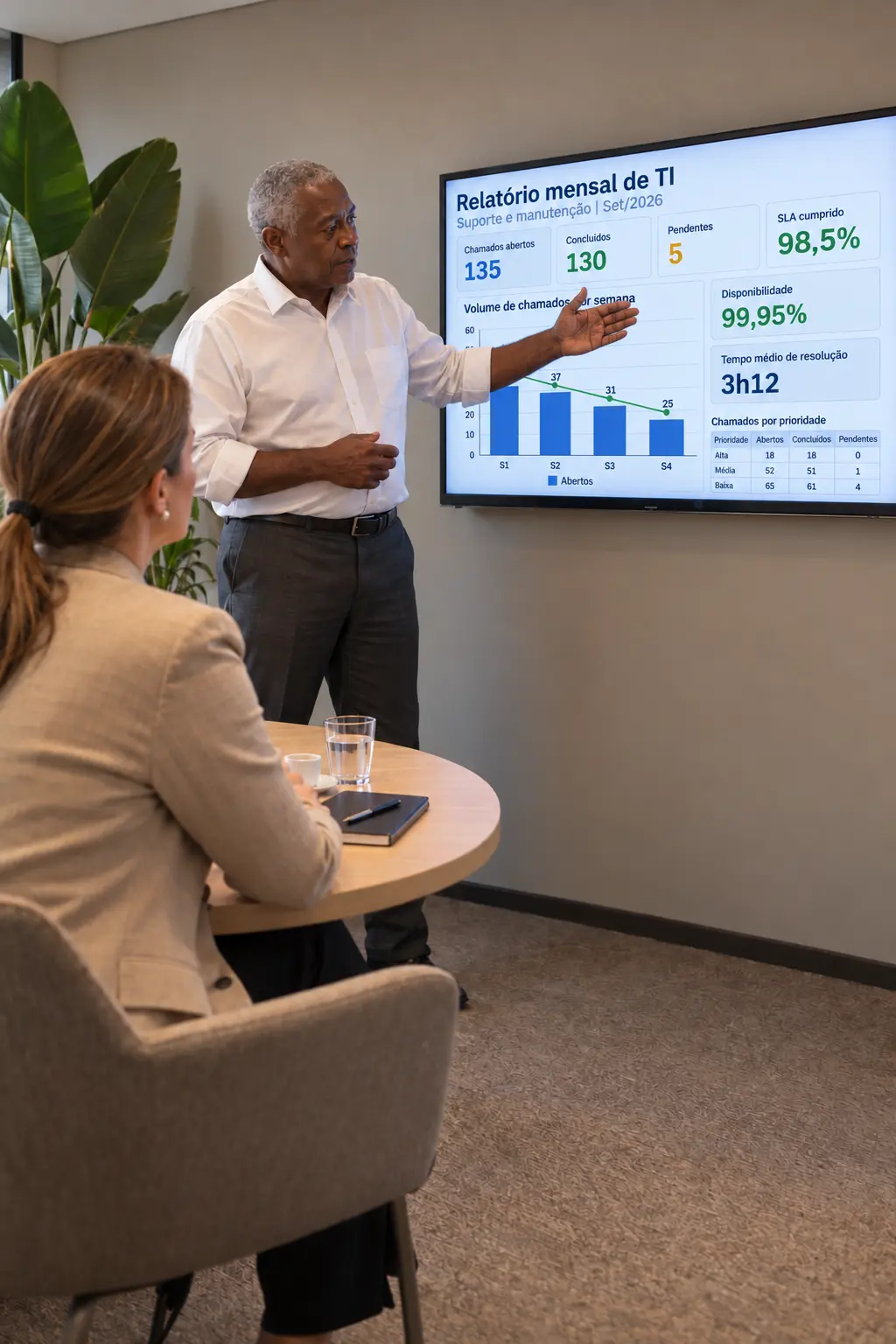
The system lead shows the monthly IT report, with the month's tickets and timelines, on the meeting-room screen to the CFO.
  • Timelines by severity

    Each level's timeline is in the contract, and the ticket shows the time left.

  • Support that knows the system

    The same team looks after the system, with one fixed point of contact.

  • Tested before going live

    Every fix and update goes through review and testing, with a rollback ready.

  • Cause on record

    Every fix states what happened, why, and what was done so it won't recur.

  • Monthly report

    Tickets, timelines, updates and risks, so the company can keep track.

  • All in the company's name

    Code, documentation and access; if you switch vendors, you take it all.

The system runs on our hosting, in the cloud or on the company's server. Explore hosting

FAQ

Before handingyour system over.

What executives and managers ask before hiring systems support.

01Do you support systems built by another company?

Yes, after an assessment. We need the code, the database and access to where the system runs. Off-the-shelf software the company only uses stays with its vendor; in that case, we take care of the integrations and whatever belongs to the company.

02What does support cover, and what's an improvement?

Anything that keeps the system working as agreed: fixing, updating and adjusting when a law, a vendor or the environment changes. A new screen, report or feature is an improvement: it goes through Application evolution, quoted and approved first.

03What's the cost?

It depends on the size of the system, the support hours and the timeline for each severity. After the assessment, our sales team sends a written proposal with the price, what's included and what's not.

04How fast do you respond?

It depends on severity: a system that's down gets the shortest timeline, and an error with a workaround gets a longer one. The timelines for each level and the support hours, including on-call coverage for critical issues, are written into the contract.

05Who at our company can open a ticket?

Anyone the company designates, through the channel set in the contract. Monitoring alerts also open tickets, without waiting for someone to notice.

06And when the law changes?

Support tracks the change and adjusts the system, with testing, before the rule takes effect, as with the invoice changes from Brazil's tax reform. When the law creates an obligation the system didn't have, the work is quoted first, as an improvement.

07Do you handle the server?

The server belongs to whoever hosts it. On our managed hosting, we take care of both. In the cloud or on your company's server, we take care of the system and agree with whoever runs the machine on who handles what.

08What about the personal data in the system?

We only access what support requires, and every access is logged. If an incident affects personal data, we notify the company right away, with what happened, so it can report to the ANPD and the people affected within the legal deadline. The contract states how we handle this data, following the LGPD.

Proposal

Tell us how the system is doing.We'll look after it.

Check what support needs to solve and tell us about the system: what it does, who built it and what goes wrong. Our sales team reads your request, schedules the assessment and sends a written proposal with what's covered, the timelines and the investment.Check what support needs to solve and tell us about the system: what it does, who built it and what goes wrong. Our sales team sends a written proposal.

What support needs to solve
Your request

Check what support needs to solve. If you're not sure yet, our team will help you figure it out.

No spam · data protected · LGPD